Prognos & Stichos: Pretrained Ink Detection and OCR-Guided Depth Ranging Across All 14 Public Herculaneum Scrolls
A transductively pretrained ink model, a synthetic-on-noise Greek letter detector for label-free Z-depth focusing, and a full AWS sweep across 311 surface volumes (7,384 cm²).
The Vesuvius Challenge now hosts 14 Herculaneum scrolls
(311 unrolled surface volumes) on public S3, scanned across different synchrotrons, energies,
and voxel pitches (2.4–9.6 μm). Yet turning those public volumes into readable Greek
still hits two practical walls:
- Focus & orientation: an unrolled surface mesh often sits tens of microns above or below the physical ink layer—or has its surface normal inverted—so running an ink detector at the default center slice can miss real writing completely.
- Cross-scroll generalization: supervised ink models trained on a handful of labeled scrolls often degrade when moved to an unseen scroll with different papyrus texture or scan contrast.
This progress report tests a concrete idea for each wall—Stichos v1 (using a synthetic-data Greek letter detector as a label-free autofocus) and Prognos v1 (self-supervised pretraining across unlabeled 3D CT from all 16 scrolls)—and applies the resulting pipeline across every public surface volume on S3.
- A new pretrained ink model (
Prognos v1): transductively pretrained on unlabeled 3D CT across 16 scrolls and fine-tuned at 384 px. Pretraining gives a solid+0.059Macro AP gain over a matched from-scratch baseline and slightly edges outargus-v3on faint-inkPHerc1447 w060AP/AUC, but it is still not SOTA—visually, publishedargus-v3remains noticeably cleaner and more legible on essentially every decoded scroll. - A Greek stroke & letter OCR detector (
Stichos v1): trained purely on degraded HomerComp papyrus layouts planted onto real scroll noise (zero fine-tuning on target scrolls) to localize strokes, Greek character classes, and letter centers. - Label-free depth autofocus with
Stichos: measuring how muchStichosletter-center activations collapse under 128 px tile shuffling automatically selects the optimal Z-depth plane and Z-normal polarity (upvs.down) on unrolled scrolls—no ink labels needed. - Full sweep across all 311 public segments (14 scrolls): browse the Interactive Explorer (defaulting to
argus-v3at ourStichos-focused depth, withPrognosone keystroke away) or download clean full-page black-and-whiteargus-v3PDFs below. Focusing on the 5 scrolls that had zero labels of any kind inPrognostraining (all decoded 100% uncropped), three of the clearest segments to jump straight into: PHerc1667 / w018 (five consecutive columns across a 209 cm² uncropped wrap; see also w031), PHerc0343 / w047 (sharp full-width line across the strip), and PHerc0306B / w074 (clear horizontal line across center; see also PHerc0211).
Why the names? We call the ink model Prognos (Ancient Greek πρόγνωσις / προγιγνώσκω, “known beforehand / already seen”), reflecting its transductive pretraining on unlabeled CT from the target scrolls before seeing ink labels. We call the letter detector Stichos (στίχος, “a line of verse / row of writing”—the papyrological unit for a line in a scroll column), reflecting its job of recognizing when ink forms coherent lines of Greek letters rather than papyrus fiber noise.
1. Stichos: Using Greek Letter Geometry as a Label-Free Autofocus
When you decode a newly unrolled segment, maximizing raw ink density across candidate Z-depths fails badly: bright cracks, mineral streaks, and delaminated adjacent wraps often trigger higher mean probability than faint carbon ink. What actually separates true writing from papyrus artifacts is spatial arrangement: ancient ink forms evenly spaced Greek letters along horizontal lines, whereas fiber texture looks much the same no matter how you scramble small patches of it.
To capture that signal without ever touching target-scroll ink labels, we trained Stichos
(code/letters_truth/letterseg.py)—a lightweight ResNet-18 U-Net taking a 1 cm ink patch
(1024×1024 px pooled to 192×192) and predicting three outputs jointly:
a clean stroke mask, a 25-class Greek character map (24 letters + background), and a 48×48
letter-center heatmap. Training data comes entirely from clean Greek papyrus layouts in the
HomerComp dataset (ICDAR 2023 Competition on Detection
and Recognition of Greek Letters on Papyri), degraded with stroke blur/erosion and planted additively onto
real scroll background noise across strong and very faint signal regimes (two independent folds,
foldA and foldB; weights on
Hugging Face: lucaswiman/stichos-v1).
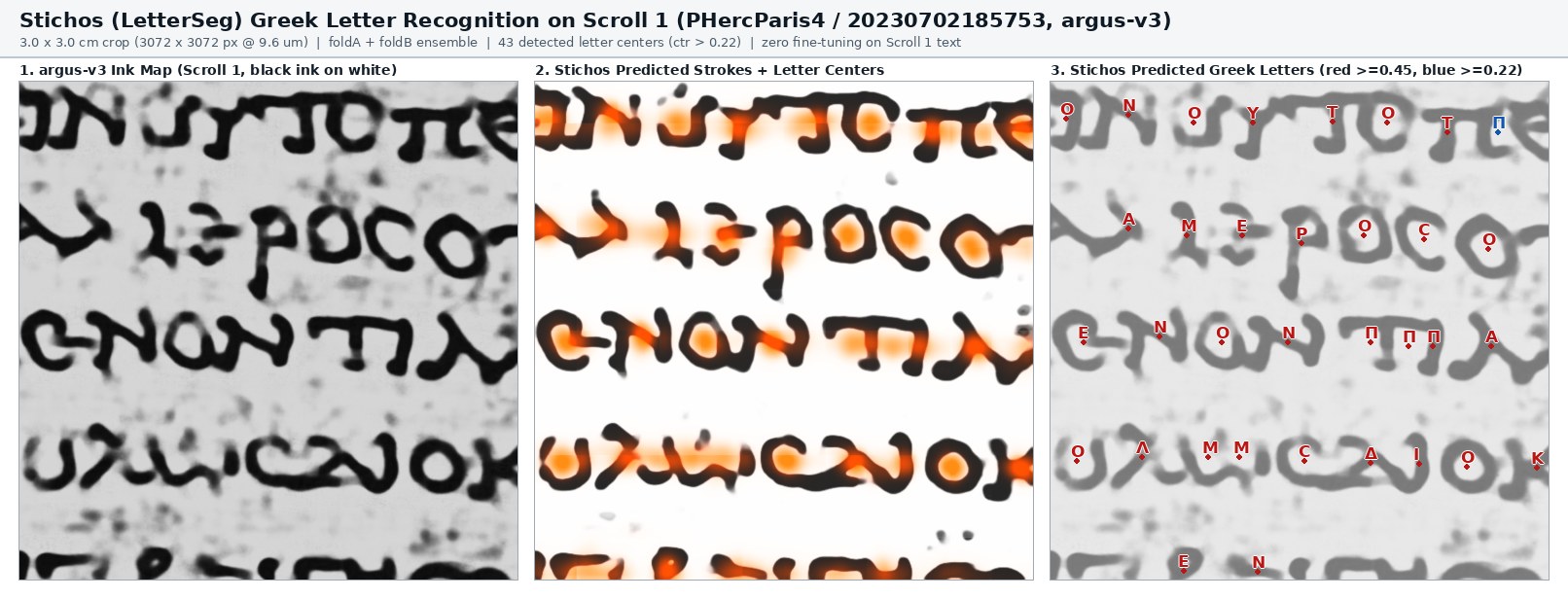
PHercParis4 / 20230702185753, argus-v3 decoding):
(1) raw black-ink-on-white argus-v3 ink across a 3.0×3.0 cm crop;
(2) Stichos predicted strokes and letter-center peaks (orange), stripping away papyrus texture;
(3) top-1 predicted Greek character at each detected center (red: center ≥0.45, blue: ≥0.22).
With zero fine-tuning on Scroll 1 text, Stichos locks onto character centers and reads clear
sequences (e.g., ΕΡΟϹΟ, ΕΝ,
ΤΟΠ, ΟΚ), while still making expected single-glyph
confusions on damaged or ligatured strokes (e.g., Ω→Ο,
ΤΙ→Π)—which is why we use it strictly for autofocus and triage, never
for word-level transcription.
Turning letter centers into a depth autofocus: Given a candidate 1 cm probability map
\(P\), we percentile-normalize it (soft_rank) and measure how much its top-40 predicted letter-center
activations drop when \(P\) is diced into an 8×8 grid of 128 px tiles and
randomly shuffled:
$$\text{Stichos}(P) = \text{ctr}(P) - \frac{1}{K} \sum_{s=1}^{K} \text{ctr}(\text{shuf}_{128}(P; s))$$
Fibers and speckles survive tile-shuffling (\(\text{Stichos} \le 0\)), while coherent lines of Greek letters
collapse when scrambled (\(\text{Stichos} \in [+0.08, +0.28]\)). Probing candidate Z-offsets
(±96 μm in 4-plane steps) × both surface polarities (up /
down) on up to six 1 cm windows automatically snaps onto the true writing plane.
Because soft_rank stretches every patch's top percentiles to [0, 1], a completely
empty or wrong-polarity slab (p99 < 0.4, ink < 0.3%) can occasionally get
amplified into faint speckles that outscore a noisy real sheet. Masking per-depth non-void CT
(ct > 5), bounding the search to ±96 μm, and penalizing near-empty
slabs (p99 < 0.50 or ink < 0.5%) eliminated these false locks cleanly.
2. Prognos: Does Transductive 16-Scroll Pretraining Close the Generalization Gap?
Even with the right Z-depth, an ink model trained on just two or four scrolls can overfit to their beamline contrast and fiber pitch. Because unlabeled 3D CT from every target scroll is always available at read time, we asked whether transductive self-supervised pretraining across all 16 scrolls would give a single backbone stronger cross-scroll transfer.
What the model predicts during pretraining:
To learn papyrus and writing-surface structure directly from unlabeled 3D CT, Prognos trains with a
three-term self-supervised objective aimed at the 3D writing interface (EMAMomentumSSL in
code/foundation/fast_ct_ops.py):
-
Masked central high-pass + depth-gradient reconstruction (weight
1.0): Mask45%of16×16spatial blocks strictly on the 8 central writing-interface planes (z = 4..11, leaving outer context planes visible) and reconstruct 16 targets inside the mask via Smooth L1 (\(\beta = 0.35\)): the 8 spatial high-pass planes \(x_z - \text{avg\_pool}_{9\times 9}(x_z)\) (stripping slow beamline illumination drift to focus on fine fiber and surface-coating relief) plus the 8 depth finite-difference planes \(\Delta_z x_z\) (capturing the vertical transition across the writing surface). -
EMA-teacher view invariance + variance floor (weight
0.25): Match bottleneck embeddings between the masked student view and an unmasked EMA-teacher view with independent±3-plane Z-jitter and contrast noise (plus a VICReg \(\text{ReLU}(1 - \sigma)\) floor), building invariance to small depth offsets and scan contrast. -
Z-polarity classification (weight
0.10): On canonically oriented Studio crops, randomly flip the 16-plane slab along Z (50%) and predictupvs.downfrom the pooled bottleneck, anchoring the encoder to the asymmetric top-vs.-bottom micro-texture of carbonized papyrus.
We streamed 319,305 fresh 320×320×16 slabs across 307 / 311 S3
segments directly into an AWS Batch L40S GPU (30k steps in 8.8 h, $16.35
total, $0 egress) to pretrain a hybrid 3D-to-2D looped-RoPE U-Net (ResUNetHybridLooped:
wide_full3d 17.84M + base_fast 10.43M). We then fine-tuned
in two stages—first at 256 px on 6-scroll dense reader-v2 pseudo-labels plus
15% human labels, then expanding the field of view to 384×384 px (~3.7 mm,
spanning multiple letters) via 2D-YaRN with calibrated hard-negative BCE+Dice and weight-space
Model Souping—while keeping PHerc0841 and PHerc1447 w058/w060 100% held out for
zero-leakage evaluation:
| Model (Zero-Shot Benchmark — Zero 0841/1447 Labels) | PHerc0841 AP/AUC | 1447 w058 AP/AUC | 1447 w060 AP/AUC | Macro AP / AUC |
|---|---|---|---|---|
Matched Scratch wide_full3d (no SSL pretraining) |
0.7209 / 0.8168 | 0.6634 / 0.8161 | 0.5422 / 0.7341 | 0.6422 / 0.7890 |
Published argus-v3 (256px, 8× TTA) |
— | 0.7429 / 0.8736 | 0.6359 / 0.7863 | — |
base_fast soup3 (10.43M, 384px 2D-YaRN) |
0.7423 / 0.8351 | 0.7115 / 0.8466 | 0.6432 / 0.8058 | 0.6990 / 0.8292 |
wide_full3d soup3 (17.84M, 384px 2D-YaRN) |
0.7618 / 0.8477 | 0.7198 / 0.8597 | 0.6221 / 0.7869 | 0.7012 / 0.8314 |
Prognos Cross-Backbone (50% wide + 50% base) |
0.7565 / 0.8438 | 0.7188 / 0.8569 | 0.6379 / 0.8002 | 0.7044 / 0.8336 |
The honest verdict: 16-scroll pretraining clearly helps—lifting Macro AP by
+0.059 over the identical from-scratch architecture and slightly edging out
argus-v3 on faint-ink PHerc1447 w060 AP/AUC. After locking the recipe, we trained
production Prognos on all 3,674 human-annotated tiles across all 4 labeled scrolls
(PHerc0814, PHerc0841, PHerc0009B, PHerc1447) plus the
6-scroll dense pack (weights + 16-scroll SSL encoders on
Hugging Face: lucaswiman/prognos-v1). Yet when you actually inspect the decoded wraps by eye, argus-v3
still produces sharper, more continuous strokes on essentially every scroll. Pixel-level AP on sparse
crops does not yet equal visual legibility—so for reading scrolls today, argus-v3 focused by
Stichos is clearly the right primary output, with Prognos kept alongside it as our
pretraining baseline.
3. Running the Pipeline Across All 14 Public Scrolls (311 Segments)
Putting the pieces together, every public S3 surface volume runs through the same five-step pipeline
(code/foundation/infer_unread_scroll.py): stream directly from S3 and resample to isotropic
9.6 μm → autofocus Z-depth and polarity with Stichos → decode with
argus-v3 and Prognos → rank 1 cm regions with Stichos →
package into the interactive explorer and wrap-ordered black-and-white argus-v3 PDFs.
We ran the full sweep across all 311 segments (7,383.8 cm² valid papyrus,
0 errors) on AWS Batch, and then re-decoded all cropped segments across the 5
strictly zero-label scrolls (PHerc1667 and PHerc0306B, joining already-uncropped
PHerc0211, PHerc0343, and PHerc0800) at 100% full uncropped
resolution locally on our DGX Spark GB10. On the other 9 scrolls, segments exceeding
6144×6144 px (~5.9×5.9 cm) kept the center-crop cap from the
AWS sweep (192 of 311 segments; flagged explicitly in the explorer header).
| Scroll | Segs | Area (cm²) | Segs ≥0.08 | argus-v3 mean (max) | Prognos mean (max) | Scroll PDF |
|---|---|---|---|---|---|---|
PHerc0009B (human-labeled) | 18 | 324.4 | 17 | +0.017 (+0.271) | +0.007 (+0.262) | PHerc0009B.pdf (3.5 MB) |
PHerc0139 (pseudo-labels only) | 38 | 1181.3 | 37 | +0.011 (+0.237) | -0.010 (+0.228) | PHerc0139.pdf (9.1 MB) |
PHerc0172 (pseudo-labels only) | 53 | 1829.6 | 53 | +0.070 (+0.275) | +0.062 (+0.272) | PHerc0172.pdf (21.1 MB) |
PHerc0211 (zero labels) | 1 | 7.6 | 1 | +0.111 (+0.195) | +0.105 (+0.192) | PHerc0211.pdf (161.7 KB) |
PHerc0306B (zero labels) | 1 | 21.6 | 1 | +0.012 (+0.167) | +0.007 (+0.186) | PHerc0306B.pdf (244.0 KB) |
PHerc0343 (zero labels) | 1 | 7.8 | 1 | +0.061 (+0.200) | +0.065 (+0.174) | PHerc0343.pdf (173.3 KB) |
PHerc0343P (pseudo-labels only) | 8 | 31.0 | 7 | +0.009 (+0.142) | -0.006 (+0.120) | PHerc0343P.pdf (911.3 KB) |
PHerc0500P2 (pseudo-labels only) | 46 | 238.2 | 25 | -0.003 (+0.187) | -0.005 (+0.165) | PHerc0500P2.pdf (4.1 MB) |
PHerc0800 (zero labels) | 6 | 9.3 | 0 | +0.000 (+0.079) | +0.039 (+0.115) | PHerc0800.pdf (629.4 KB) |
PHerc0814 (human-labeled) | 19 | 122.4 | 11 | +0.003 (+0.204) | +0.005 (+0.172) | PHerc0814.pdf (2.0 MB) |
PHerc0841 (human-labeled) | 3 | 37.4 | 3 | +0.050 (+0.187) | +0.036 (+0.183) | PHerc0841.pdf (681.4 KB) |
PHerc1447 (human-labeled) | 18 | 103.8 | 8 | +0.012 (+0.198) | -0.006 (+0.215) | PHerc1447.pdf (1.9 MB) |
PHerc1667 (zero labels) | 19 | 1083.8 | 17 | +0.006 (+0.269) | -0.018 (+0.202) | PHerc1667.pdf (4.5 MB) |
PHercParis4 (Scroll 1 (no pack labels)) | 80 | 2385.7 | 76 | +0.071 (+0.321) | +0.025 (+0.266) | PHercParis4.pdf (24.7 MB) |
4. Selected Excerpts from the 5 Strictly Zero-Label Scrolls
To evaluate behavior on scrolls that contributed zero labels of any kind to Prognos
supervised training—neither human ink labels nor reader-v2 pseudo-labels (excluding Scroll 1 /
PHercParis4)—below are black-and-white comparisons of argus-v3 and
Prognos across PHerc1667, PHerc0211, PHerc0343,
PHerc0306B, and PHerc0800, with the top-2 Stichos 1 cm zooms underneath.
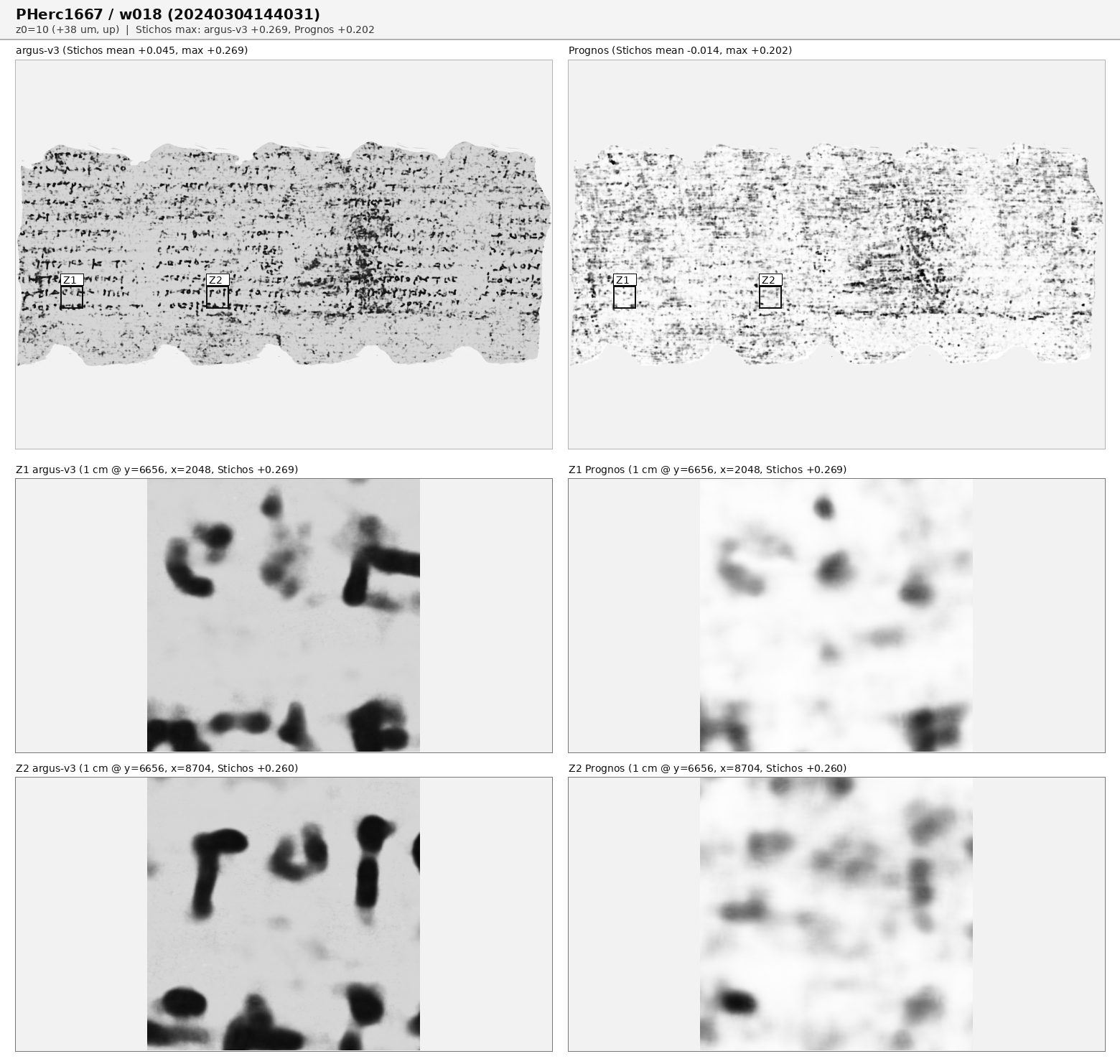
PHerc1667 / w018 (20240304144031) — Peak 1 cm argus-v3 Stichos +0.269 (208.8 cm²)
Auto-ranged by Stichos to z0=10 (+38 um, polarity=up) across 800 valid 1 cm frames. argus-v3 reached peak Stichos +0.269 (mean +0.045, ink share 11.5%) vs. Prognos +0.202 (mean -0.014, ink share 4.6%). (Open in explorer · PHerc1667.pdf)
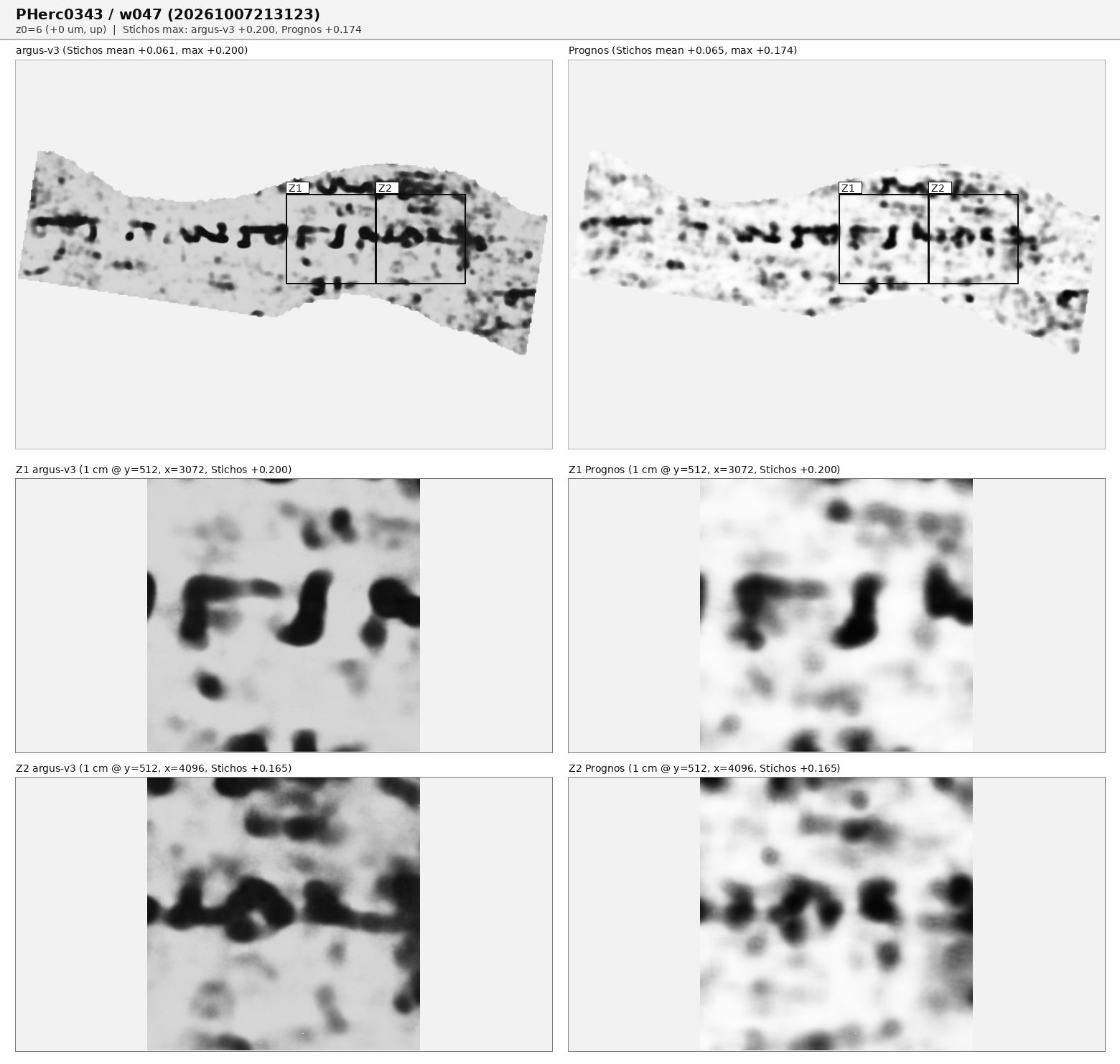
PHerc0343 / w047 (20261007213123) — Peak 1 cm argus-v3 Stichos +0.200 (7.8 cm²)
Auto-ranged by Stichos to z0=6 (+0 um, polarity=up) across 17 valid 1 cm frames. argus-v3 reached peak Stichos +0.200 (mean +0.061, ink share 18.3%) vs. Prognos +0.174 (mean +0.065, ink share 11.4%). (Open in explorer · PHerc0343.pdf)
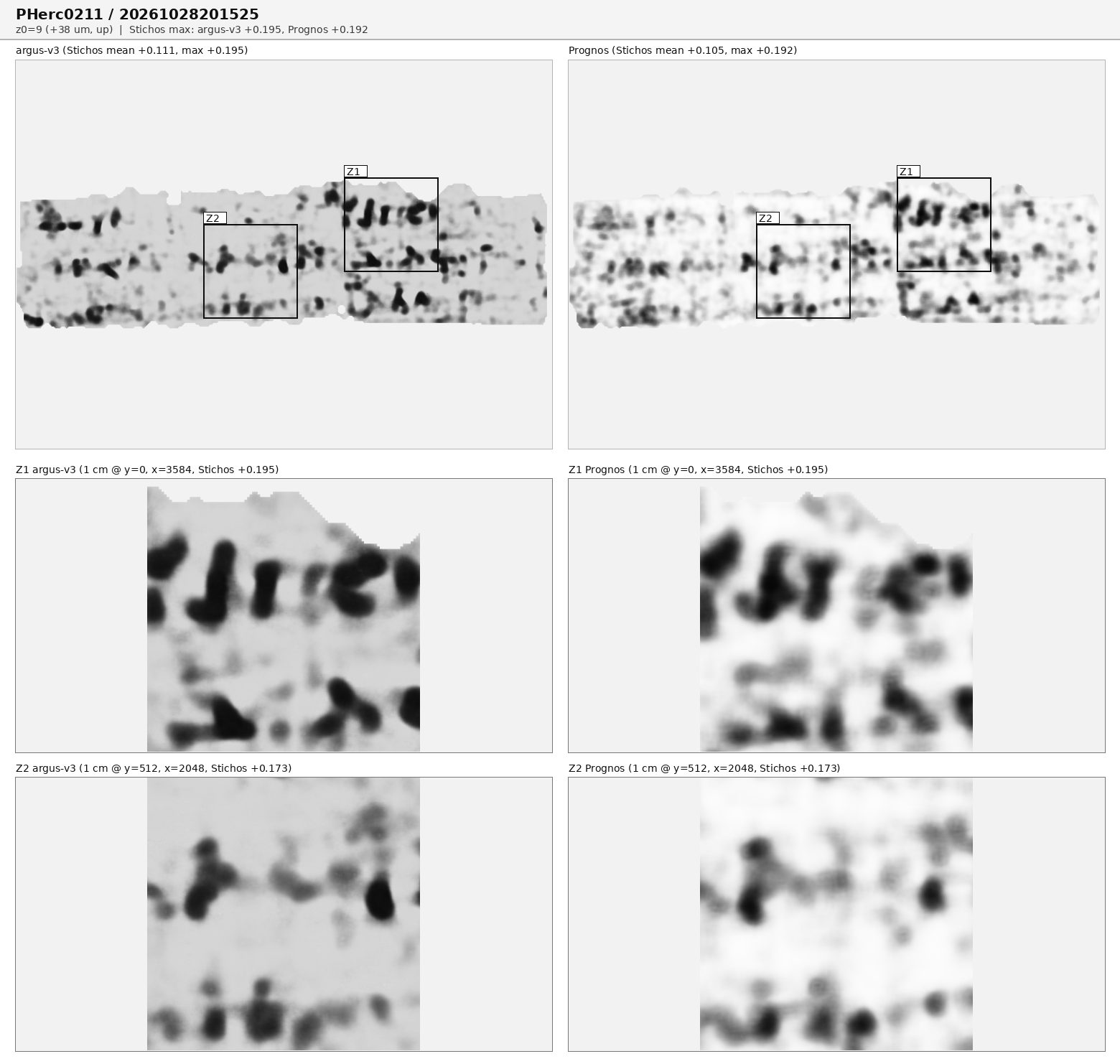
PHerc0211 / 20261028201525 — Peak 1 cm argus-v3 Stichos +0.195 (7.6 cm²)
Auto-ranged by Stichos to z0=9 (+38 um, polarity=up) across 19 valid 1 cm frames. argus-v3 reached peak Stichos +0.195 (mean +0.111, ink share 13.2%) vs. Prognos +0.192 (mean +0.105, ink share 8.8%). (Open in explorer · PHerc0211.pdf)
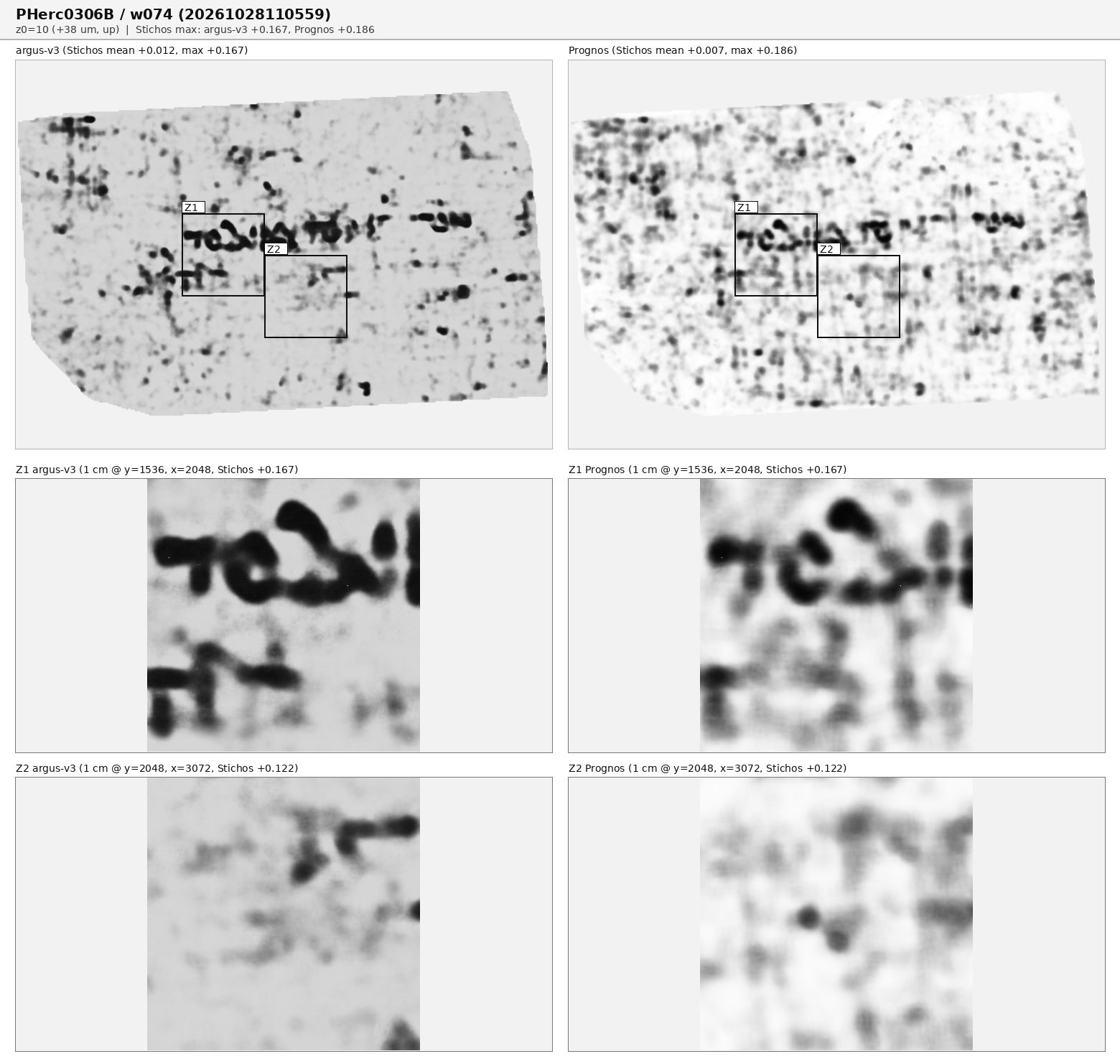
PHerc0306B / w074 (20261028110559) — Peak 1 cm argus-v3 Stichos +0.167 (21.6 cm²)
Auto-ranged by Stichos to z0=10 (+38 um, polarity=up) across 62 valid 1 cm frames. argus-v3 reached peak Stichos +0.167 (mean +0.012, ink share 7.7%) vs. Prognos +0.186 (mean +0.007, ink share 5.3%). (Open in explorer · PHerc0306B.pdf)
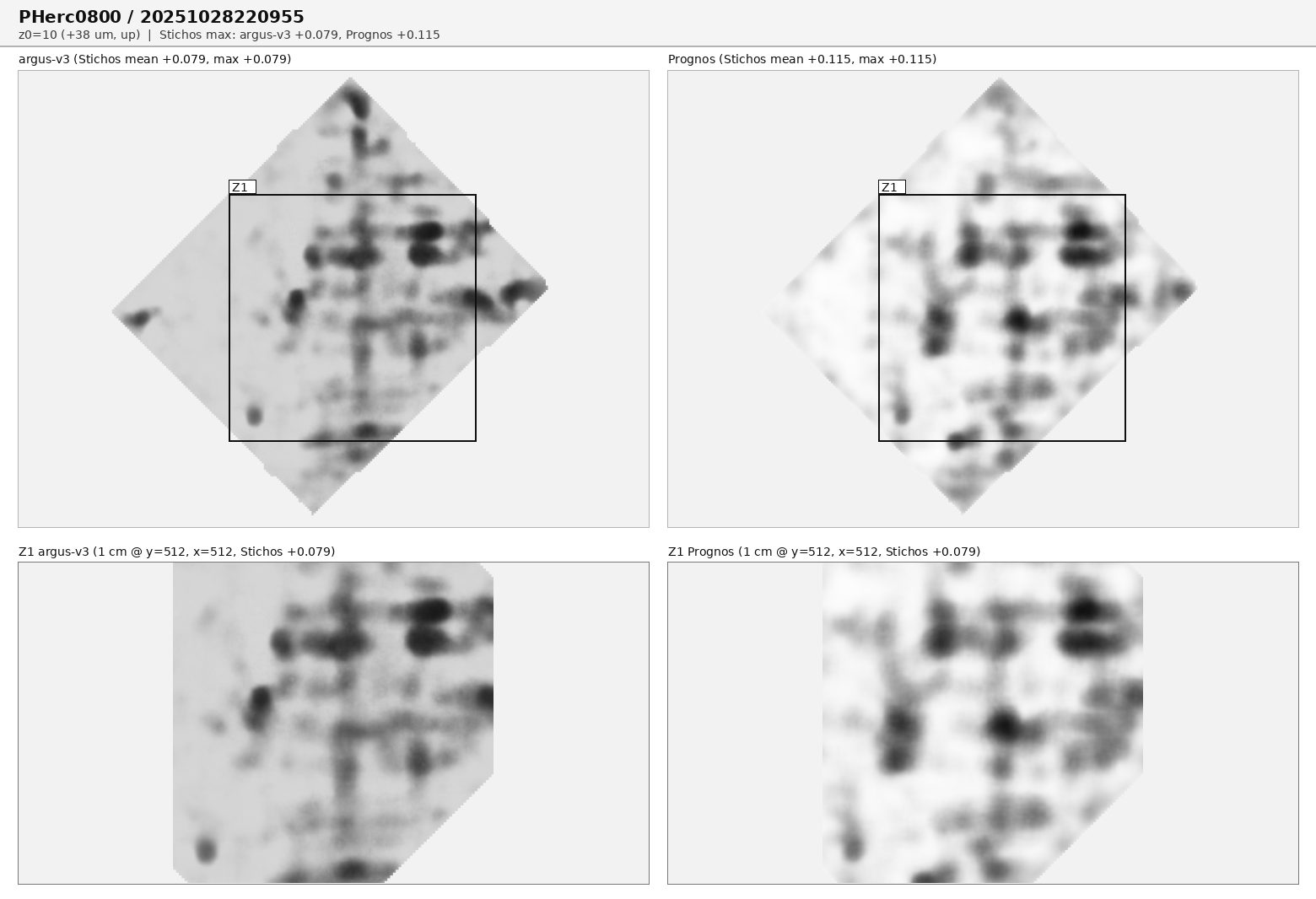
PHerc0800 / 20251028220955 — Peak 1 cm argus-v3 Stichos +0.079 (1.5 cm²)
Auto-ranged by Stichos to z0=10 (+38 um, polarity=up) across 1 valid 1 cm frames. argus-v3 reached peak Stichos +0.079 (mean +0.079, ink share 11.1%) vs. Prognos +0.115 (mean +0.115, ink share 6.9%). (Open in explorer · PHerc0800.pdf)
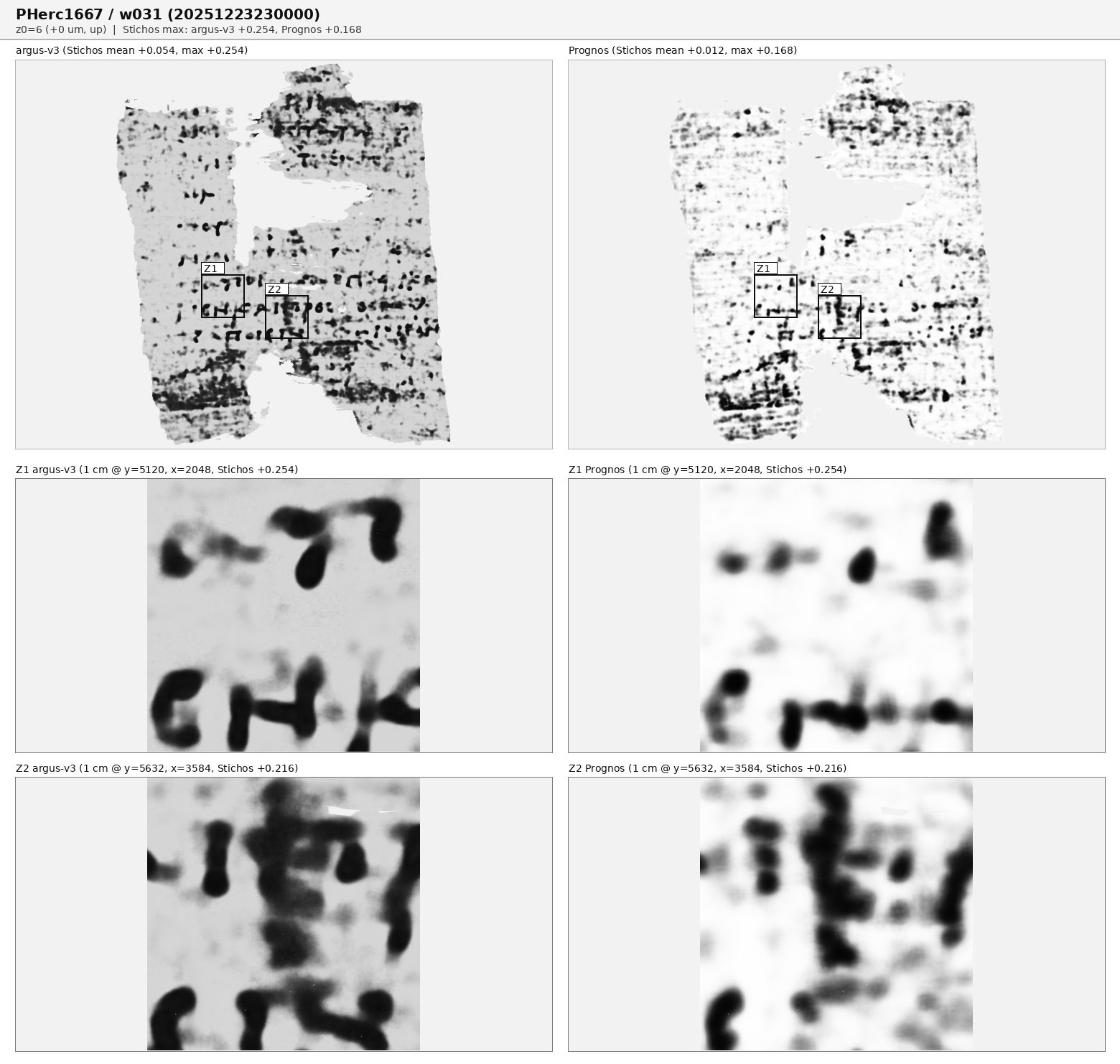
PHerc1667 / w031 (20251223230000) — Peak 1 cm argus-v3 Stichos +0.254 (45.8 cm²)
Auto-ranged by Stichos to z0=6 (+0 um, polarity=up) across 155 valid 1 cm frames. argus-v3 reached peak Stichos +0.254 (mean +0.054, ink share 19.2%) vs. Prognos +0.168 (mean +0.012, ink share 8.3%). (Open in explorer · PHerc1667.pdf)
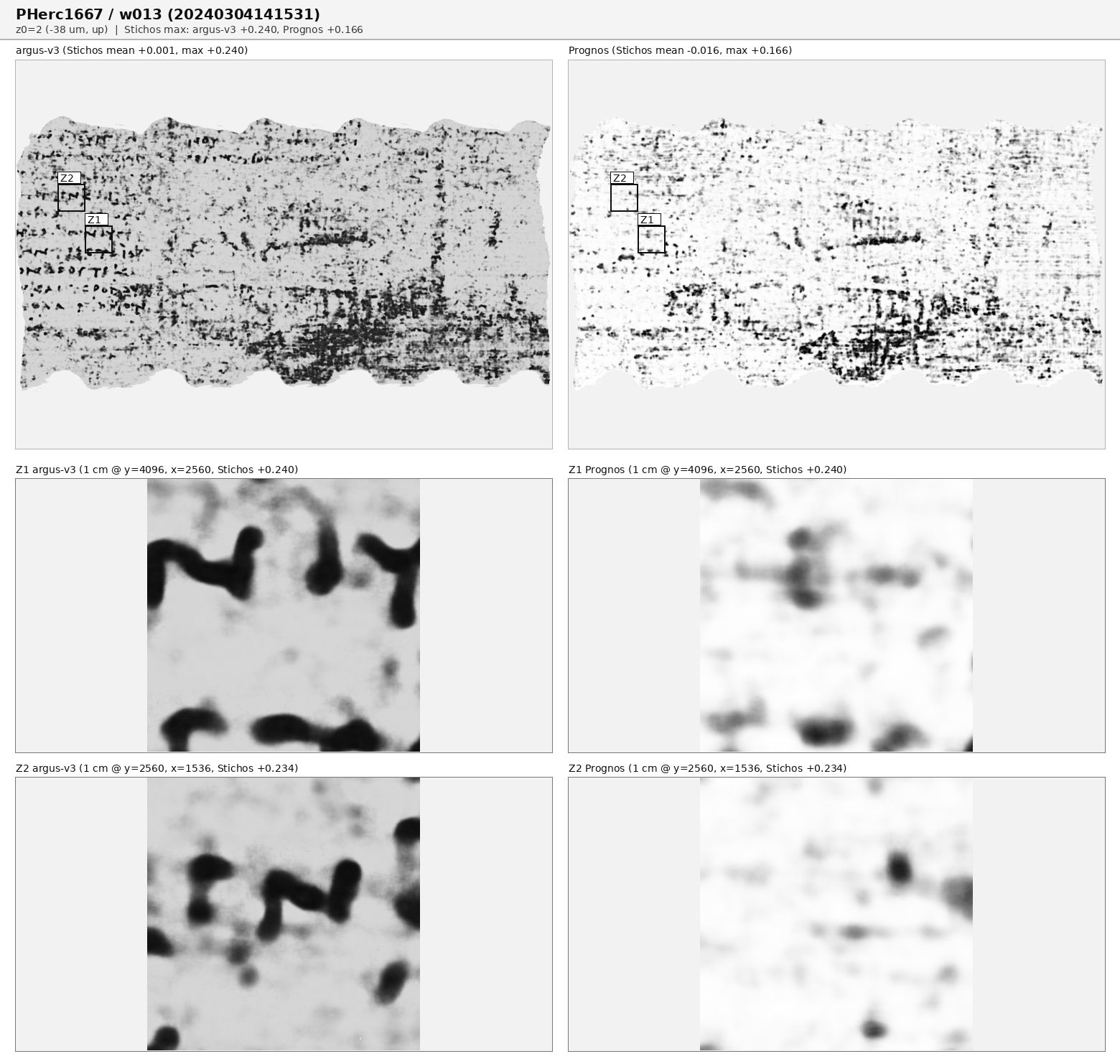
PHerc1667 / w013 (20240304141531) — Peak 1 cm argus-v3 Stichos +0.240 (169.9 cm²)
Auto-ranged by Stichos to z0=2 (-38 um, polarity=up) across 644 valid 1 cm frames. argus-v3 reached peak Stichos +0.240 (mean +0.001, ink share 17.8%) vs. Prognos +0.166 (mean -0.016, ink share 6.9%). (Open in explorer · PHerc1667.pdf)
5. Takeaways & What’s Next
- Label-free OCR autofocus works right out of the box:
Stichosreliably locks onto the right Z-plane and surface normal across diverse synchrotron scans without needing a single target-scroll ink label, immediately improving what you get out of existing ink models likeargus-v3. - Multi-scroll SSL clearly helps, but visual sharpness still lags
argus-v3: transductive pretraining on the 3D writing interface delivers a large+0.059Macro AP jump over training from scratch, yetargus-v3still resolves cleaner, more continuous letter strokes visually. Understanding and closing that gap between pixel-level AP and stroke continuity is our main modeling question next. - Next steps: investigate why
argus-v3preserves sharper stroke topology thanPrognos(receptive field, loss weighting, or dense pseudo-label calibration), useStichos-selected high-confidence regions for label-free test-time adaptation on unread scrolls, and expand uncropped decoding as new public scroll segments land on S3.
Appendix: Earlier Negative Experiments, Pipeline & Dataset Footprint (311 segments, 9.71B pixels)
Curvature & surface-relief pretraining (dropped): Earlier we tested predicting
rank-normalized local curvature and surface relief from 3-plane CT crops (code/foundation/plane_joint.py).
Although both CT geometry losses dropped steadily during pretraining, frozen-probe evaluations showed they did
not transfer to ink detection—Scroll 1 local ink ranking stayed near chance and a frozen random
encoder was competitive on the geometry probes—so we replaced them with the masked central
high-pass + depth-gradient + EMA-invariance objective in Section 2.
| Artifact | Size (311 segs) | Contents & Format |
|---|---|---|
| Whole-Scroll Explorer WebP maps | 28.4 MB | All 311 segments × 2 models (argus-v3, Prognos), grayscale WebP (up to 2048–2560 px on uncropped zero-label wraps, 1280 px for other Stichos ≥ 0.08 segments, 640 px otherwise). |
| 14 Per-Scroll Folio PDFs | 73.7 MB | Cover index + 1 clean full-page black-and-white decoded argus-v3 plate per segment (325 pages total, ordered in physical wrap/spatial sequence, up to 2200 px long edge). |
Full-res maps_u8.npz archive |
7.91 GB | Compressed uint8 probability maps + non-void mask at full 9.6 μm resolution. |