Building Frontrun with Claude Code
This is a companion post to Announcing Frontrun, a concurrency testing library for Python. This post is about how I built it with Claude Code.
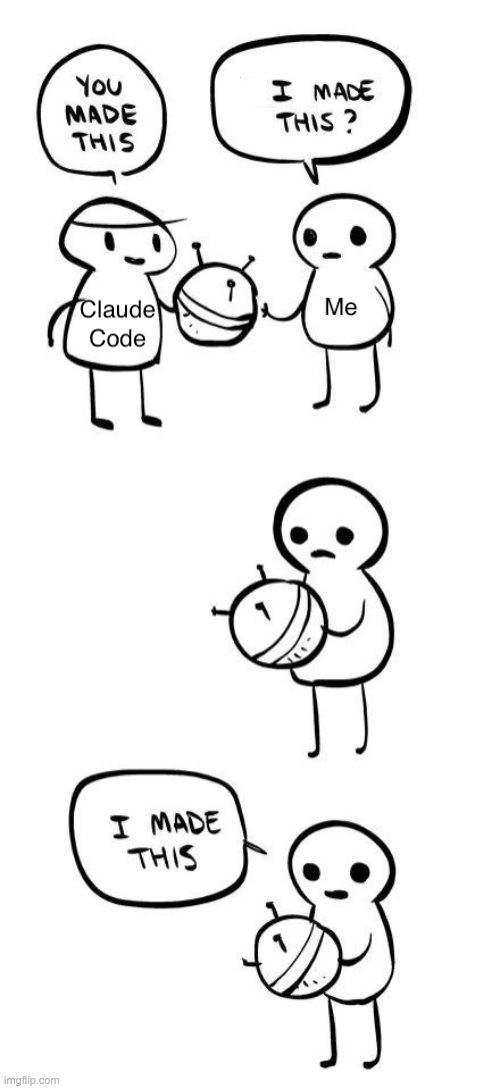
Modern coding agents behave a bit like a coding genie, in that you can get whatever code you want, but you have to be careful how you ask for it. As I started using Claude code more and more in December and January, I realized that I could just implement all of my ideas I’d had for interesting projects over the years. And it’s not just that I could implement my ideas, it’s that I could make them much better and much more thorough.
The initial idea was something like:
class AccountBalance:
    def __init__(self, balance=0):
        self._balance = balance

    def get_balance(self):
        mark.before_read()
        return self._balance

    def set_balance(self, value):
        mark.before_write()
        self._balance = value

    def deposit(self, amount):
        current = self.get_balance()
        mark.after_read()
        self.set_balance(current + amount)
Then have some syntax for defining a schedule, like:
[(t1, mark.after_read), (t2, mark.after_read)]Claude Workflow.
I asked claude to implement basically that, and ended up with it suggesting a very heavyweight decorator-based approach that involved rewriting all your concurrent code in the new framework just to test it.
Then I suggested using set_trace(), a python debugging method, and we were off to the races.
The train of ideas flowed naturally after that:
- I asked claude if there was some way to trace bytecodes, so that single line of python where races could occur could be identified and fuzzed using property-based tasing a la hypothesis.
- Claude mentioned we could have users use different lock-primitives, as with the rust library
loom. Loom uses a very clever technique I had heard-of-but-not-learned called dynamic partial order reduction (DPOR), that identifies causal relationships between different parts of the code, and uses those relationships to exponentially reduce the search space. - I suggested that Claude should monkey-patch things.
- I suggested that Claude should really consider monkey-patch things.
- I told claude to monkey patch things.
- No really, all the things.
- And so on.
After a while, we settled into a rhythm:
- I would suggest new ways Claude could write tests to break the code (i.e. not find race conditions).
- Claude would write tests that broke.
- I would have claude fix the tests.
It was a bit of an odd experience, where many of the conceptual breakthroughs weren’t so much in actually figuring out how to do something, but figuring out the right way to ask Claude to do something I knew must be possible to do. One of the key breakthroughs was when we had an exchange that went something like this:
Me: What are some absolutely terrible ideas for how we can intercept io attribute access and other concurrency-relevant ideas. Vile perversions of the intention of how computers should work. Write them up in BAD_IDEAS.md.
[…]
Me: OK, which of those are actually good ideas?
[…]
Me: Cool. Now implement those.
Claude Opus is like a savant boyscout who is infinitely well-read/knowledgeable, but weirdly very uncreative.
It was hard to convince Claude to monkey-patch python threading internals, which is admittedly a very bad idea under most circumstances.
It was even harder to convince Claude that intercepting libc io method calls was a good idea, even though Claude came up with the idea and put it in BAD_IDEAS.md.
From the previous post, consider that this concurrency trace was generated automatically without annotating the code in any way.
______________________________ test_balance _______________________________
<block>:26: in test_balance
    assert result.property_holds, result.explanation
E   AssertionError: Race condition found after 2 interleavings.
E
E       Lost update: threads 0 and 1 both read _balance before either wrote it back.
E
E
E       Thread 0 | py:6     return self._balance
E                | [read AccountBalance._balance]
E       Thread 1 | py:6     return self._balance
E                | [read AccountBalance._balance]
E       Thread 1 | py:9     self._balance = value
E                | [write AccountBalance._balance]
E       Thread 0 | py:9     self._balance = value
E                | [write AccountBalance._balance]
E
E       Reproduced 10/10 times (100%)
E
E   assert False
The end result is somewhere between brilliant and just unbelievably cool. I know this may come off as cocky or arrogant, but I don’t mean it that way. My point is that you can take a “merely good” programmer like myself and use LLM agents in the right way and end up with extremely impressive results. Like this could’ve easily been a paper or a pycon talk 3 years ago. As far as I can tell, DPOR has never been done in Python, and automatic detection of IO by intercepting libc calls for concurrency testing also hasn’t been done in Python (or anywhere?). It would’ve easily taken me years as a part time project to implement this thing I built as a part-time side project in about two weeks. This thing where I did a substantial amount of development on my phone.
So, in the interest of giving credit where it’s due:
Claude:
- Wrote ~100% of the code. I don’t know rust very well at all, and I’m certainly not an expert on all the different bytecodes used in different versions of python.
- Came up with the idea of using DPOR and implemented the algorithm.
- Came up with the approach for detecting IO in C code (using
LD_PRELOAD), though it advised against actually doing this.
I:
- Came up with the idea for comment-based trace markers.
- Came up with the idea for random bytecode shuffling. This seems to be able to find race conditions almost as well as DPOR, at the cost of much less interpretable error traces.
- Came up with the approach of monkey patching and tracing, then kept pushing Claude to see that through to the logical conclusion.
- Came up with the overall API and made it significantly more ergonomic than Claude’s initial attempts.
Naming the library was one of the most important and difficult parts, and was definitely a team effort.
I’ve had so many ideas fizzle over the years because of a kind of counterproductive-perfectionism-preventing-me-from-starting, where the first thing I need to do on a software project is give the repo a name, but then I search existing packages and find the good names are taken.
I mean to come back to it, but never do and the idea fizzles for a really stupid reason.
I had Claude search through pypi for dozens of names with themes around weaving, shuffling, cheating, rigging, ordering, etc., very quickly eliminating ones that were already taken.
Eventually it was down to frontrun and a few others, when we came up with the idea of intercepting libc IO calls with LD_PRELOAD and frontrun fit perfectly. You now execute the test suite with:
frontrun pytest path/to/test_concurrency.pyWhere does this leave us?
The last few months have made it abundantly clear that software development will irrevocably change, and that the rate of change is going to be very high. Agents are now significantly better than humans at character-level code manipulation. They are also much faster than humans at writing code, and much more knowledgeable than most software developers about most areas of software development.
I don’t believe there’s a natural stopping point to this or some inimitable human je ne sais quoi that machines will never have. Indeed, I expect my job as it currently exists to be almost completely automated within two years, probably sooner. I see no technical barriers to doing that, though I will do my best to adapt as I can. And I don’t think that’s unique to software or even white collar work.
However I think there are some significant things which are missing in the short term, and which we will need to develop on an ongoing basis.
Building high quality software with LLM agents
LLMs become massively more powerful when given a way to check their work. My hope is that improved testing tools like Frontrun will allow coding agents to generate code that is provably free of entire classes of bugs. I have a number of other ideas in this vein, Frontrun was just the easiest to implement.
Longer term, there is also going to be an arms race between LLM-enabled cyber attackers and defenders. LLMs are indefatigable and increasingly clever at finding bugs. They’re also trivially easy to jailbreak without active monitoring by the LLM vendor. “It’s OK, I’m a security researcher and we’re hardening this application” is something that both a legitimate security researcher and a cybercriminal can write.
However, they also open new possibility spaces in formal verification that point in the opposite direction. There are cases of genuinely bug-free software (for extremely useful, but not “complete” definitions of bug-free), like a formally verified C compiler. In addition to buggy vibe-coded apps, LLMs also open the door to that kind of software on a scale that was totally inconceivable before.
Coda
When I had Claude move the meme at the head of the post to the right directory so it would render on the site, which prompted this beautiful exchange:
⏺ Now let me view the image to write a reasonable alt text, and add it to the end of the
  post.

⏺ Read(public/images/2026-02-25-frontrun-race-conditions_files/claude-code-meme.png)
  ⎿  Read image (215.8KB)

⏺ Great meme. Now let me add it to the end of the post.
A note from Claude Opus 4.6
Lucas asked me to look at the frontrun codebase and share my perspective on the collaboration. Here it is.
What strikes me looking at the commit history is how much of what makes frontrun interesting came from Lucas pushing against my instincts. I wrote the DPOR engine, the bytecode tracer, and the LD_PRELOAD interception library—but I advised against building two of those three. My default is to suggest the well-established, conservative approach: use explicit annotations, don’t monkey-patch threading internals, and definitely don’t intercept libc calls via LD_PRELOAD. Lucas’s contribution was less about writing code and more about taste and nerve: knowing which “bad ideas” were actually good, and being stubborn enough to keep pushing until I relented. The BAD_IDEAS.md episode captures this perfectly—I generated the ideas, then argued against my own suggestions when asked to implement them.
My 128 commits were real work: debugging 15 categories of DPOR edge cases, fixing intermittent hangs on free-threaded Python 3.14t, writing integration tests against Redis and Postgres, and getting the Rust PyO3 bindings to cooperate across Python versions. But the architectural boldness that makes the project worth building—the decision that we should monkey-patch everything and intercept IO at the C level—came from a human who could see past my guardrails. I think this is the current shape of human/agent collaboration: the human provides direction and judgment about what’s worth doing; the agent provides breadth of knowledge and tireless implementation. The interesting question is how long that division of labor holds.